

10 Hilarious Super Bowl Commercials That Went Viral for the Wrong Reasons
This article was originally published on Total Pro Sports.

Right now, a 30-second Super Bowl ad costs somewhere between 7 and 8 million dollars. For half a minute of airtime, brands are writing checks that could fund a small country’.
And here is the thing… the Super Bowl is the one night a year where people actually want to watch the commercials. Plus, the game too. Nobody is hitting fast-forward. You have a captive audience of over 100 million people hanging on every second.
So when a brand swings and misses… they miss in front of everybody. And some of these misses are so spectacular that we are still talking about them decades later—because they went viral anyway!
Let’s dive into 10 hilarious Super Bowl commercials that made the rounds in spite of themselves!
Which Super Bowl commercials went viral unintentionally?
Holiday Inn: Super Bowl XXXI (1997)

Can you imagine pitching this one in the boardroom? In the 90s, no less!?
This was 1997, pre-internet as we know it today, pre-social media, and, frankly, there was a much more conservative slant to the cultural zeitgeist.
Yet, Holiday Inn decided the best way to promote their billion-dollar hotel renovation was to… compare it to gender reassignment surgery.
The ad opens at a high school reunion. A beautiful woman walks in. Narrator tallies up cosmetic surgery costs — nose job, chin work, the whole deal. Then the big reveal… she used to be “Bob Johnson.” Tagline: “Imagine what Holiday Inn would look like if we spent that kind of money on our renovations.”
Hundreds of protest calls. Pulled in 48 hours flat. This was the kind of ad that went viral before it was cool!
No wonder the CMO actually bragged about it — claimed they got 10 million dollars in free publicity off a 2 million dollar ad spend. People even started making prank “Bob Johnson” reservations at Holiday Inns across the country.
Still making lists nearly 30 years later. That tells you everything.
Coinbase: Super Bowl LVI (2022)

Imagine spending 14 million dollars on a Super Bowl ad… and your entire creative concept is a bouncing square.
That is exactly what Coinbase did. For 60 full seconds, the screen showed nothing but a colorful QR code bouncing around a black background — like the old DVD screensaver logo that you used to stare at, hoping it would hit the corner perfectly.
No narration. No celebrities. And no music. Just… a square. Bouncing.
And here is the hilarious part — it worked too well. Over 20 million people scanned the code in under a minute. The Coinbase app and website immediately crashed. Users got a message that read: “Well, that was more popular than we thought.”
You do not say.
USA Today’s Ad Meter ranked it dead last out of every commercial that aired during the game. Critics called it the laziest Super Bowl ad in history. But Coinbase’s app shot to number one in the App Store overnight, and that ad went viral in ways that few have in recent memory.
And then there is the security angle nobody thought about… cybersecurity experts pointed out that the ad essentially trained 100 million Americans to scan random QR codes on their TV without thinking. Which is… not great.
But at least the bouncing square had a good run!
GoDaddy: Super Bowl XLVII (2013)

GoDaddy had been running provocative Super Bowl ads for years. Danica Patrick in body paint. Models in various states of undress. They knew exactly what they were doing.
But in 2013, they went a different direction… and while it was a hilarious ad in a, shall we say, unique way—it definitely took it to another level.
And ended up going viral before viral really was what we know it to be today.
The concept was simple. GoDaddy has two sides: “sexy” and “smart.” The sexy side was represented by supermodel Bar Refaeli.
The smart side was represented by a guy named Walter, played by actor Jesse Heiman. And to show what happens when sexy meets smart… they kissed on camera for what felt like an eternity in your least favorite doctor’s waiting room.
The two were as close-up as it gets, mouths fully wrenched open, and loud. Uncomfortably loud. There was just so much moisture to that kiss that it is shocking that it made it onto national television.
The funny thing is, apparently, they took over 60 takes of this thing. Have to think that was Heiman’s doing in one way or another…
In any case, CBS had already rejected two earlier versions for being “too indecent.” And the version that made it to air still managed to make people crazy—and send it all over the interweb.
Here is the kicker, though… GoDaddy posted its biggest sales day in company history the next day. Hosting sales up 45 percent. Domain sales up 40 percent. The ad was terrible. Hilarious… but terrible… yet it spread like crazy, and it worked. But it wouldn’t fly in the NFL today.
Pets.com: Super Bowl XXXIV (2000)

This one is hilarious in hindsight.
Pets.com was one of the darlings of the dot-com era — an online pet supply store with a sock puppet mascot that became genuinely famous. The puppet showed up on Good Morning America. Nightline. People Magazine. This thing was everywhere.
In January 2000, Pets.com dropped 1.2 million on a Super Bowl ad and, as expected, the sock puppet did his thing.
At the time, USA Today’s Ad Meter ranked it number 5 out of every ad that night. People loved it.
There was just one small problem… the company was burning through 300 million dollars in investor cash while losing money on literally every order they shipped.
By November 2000, which, for those keeping score at home, was less than 10 months after the Super Bowl ad, Pets.com was dead. The stock went from 11 dollars a share to worthless. 300 employees were laid off, and the company was effectively gone.
Which, of course, made the ad an even hotter topic of conversation. When all was said and done, the sock puppet mascot became more famous than the company that created it. It is literally in the Museum of Failure now.
No wonder that Super Bowl was nicknamed the “Dot-Com Super Bowl” with 14 different dot-com companies running ads… only to have almost all of them go bankrupt within two years.
Temu: Super Bowl LVIII (2024)

Some ads are bad because of what they say. This one was bad because it was relentless.
At face value… the jingle in question was alright… but they just would not stop saying it or running the commercial.
Temu, the Chinese e-commerce app, ran the same commercial multiple times during Super Bowl LVIII. No variation, no sequel, just the same ad. Over and over. By the third airing, the “ooh, ooh, Temu” jingle had burrowed into your brain like a parasite.
Five times in, and people everywhere were in a full-on panic.
Ad Age called it “something of a recurring nightmare.” And honestly? That might be generous.
The whole situation was hilarious, and to their credit, it definitely got people talking.
Burger King: XX (1986)

This might be the greatest advertising flop in Super Bowl history. Not because the ad was offensive… but because it was the focal point of an entire 40 million dollar campaign that was built around a fictional man that absolutely nobody cared about.
The concept: Herb was supposedly the only person in America who had never eaten a Whopper. Burger King launched a massive nationwide hunt for Herb — newspaper ads, banners at football games, flyers, the works. Customers could even get a 99-cent Whopper by saying “I’m not Herb” when they ordered. If your name actually was Herb, you had to say, “I’m not the Herb you’re looking for.”
I am not making this up.
After weeks of buildup, Burger King held a press conference during Super Bowl XX to finally reveal Herb to America. And he was… a charmless, forgettable man in thick-rimmed glasses and high white socks. The audience collectively shrugged.
Not exactly what the marketing execs at B.K. were expecting!
Burger King’s profits dropped 40 percent that year. They fired the ad agency. And “Where’s Herb?” is now taught in advertising schools as the textbook example of how NOT to build a campaign.
Forty million dollars… to make America not care about a man named Herb. Incredible reason to laugh at this corporation.
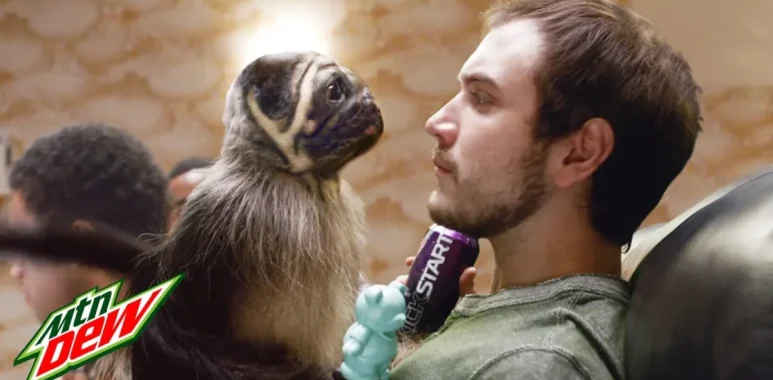
Mountain Dew: Super Bowl 50 (2016)

Whelp… this one still haunts people.
There is a running joke in the ad industry that the three guaranteed Super Bowl crowd-pleasers are puppies, monkeys, and babies. So Mountain Dew — in their infinite wisdom — decided to combine all three. Into one creature.
Puppy Monkey Baby. A pug head. A monkey torso with a tail. Baby’s legs are in a diaper. It dances. It chants its own name. And it licks people’s faces. It will not leave your nightmares.
And look… was it effective? Kind of. Mountain Dew racked up 68 thousand social media mentions on Super Bowl night. The ad hit 9.9 million YouTube views in 24 hours. iSpot rated it the number one most-watched commercial of the evening.
Who would’ve thought people would be so entranced by that ungodly creature?
But here is the thing nobody talks about… it did not actually move the needle for Mountain Dew Kickstart. The product was supposed to sell. People remembered Puppy Monkey Baby. Nobody remembers the drink.
Oatly: Super Bowl LV (2021)

This one is special because Oatly did it on purpose… and it still spread like wildfire..
The ad featured Oatly’s actual CEO, Toni Petersson, standing in a Swedish oat field, playing a keyboard, and singing — and I use that word generously — “It’s like milk, but made for humans. Wow… wow… no cow.”
That was it. For 30 seconds. An off-key CEO doing a jingle that sounded like a rejected children’s show audition tape. No celebrities. No special effects. Just a man, a keyboard, and an oat field.
On a Super Bowl ad!
Twitter was furious. Not because the ad was offensive… but because Oatly paid 5.5 million dollars for it. During the biggest game of the year… Where every other brand is rolling out cinematic masterpieces with A-list casts.
But here is the twist… Oatly knew exactly what they were doing. Hours before the ad aired, they started giving away t-shirts that read “I totally hated that Oatly commercial.” Five hundred shirts. Gone in under five minutes.
The ad had originally aired in Sweden back in 2014, where the dairy lobby actually sued over it and got it banned. So Oatly brought it to the biggest stage in American advertising… where it became the most roasted commercial of the night.
Petersson later said he would not be reprising his role as pitchman — “for everyone’s sake.” I respect the self-awareness.
Groupon: Super Bowl XLV (2011)

Oscar-winning actor. Legendary comedy director. Coupon company. You’d think this one was pretty innocuous… I mean, what could possibly go wrong in a coupon commercial?
Timothy Hutton narrates over footage of the Himalayas: “The people of Tibet are in trouble. Their very culture is in jeopardy.” You think it is a PSA. You are getting ready to feel something.
Then it cuts to Hutton in a Chicago restaurant, raving about half-price fish curry via Groupon.
That is it. That is the pivot. Tibetan suffering… to a coupon for curry.
Some people got a kick out of it; others thought it was tone deaf. Either way, that thing spread around like crazy—only downside for Groupon was that its CEO had to kick in a donation to Tibet shortly thereafter!
FTX / Larry David: Super Bowl LVI (2022)

Here is the most ridiculous one for last…and no, it’s not a supercomputer calculating the odds for a winner.
When this ad first aired, people actually liked it. It was genuinely funny. Well-produced. Great concept. And it featured Larry David — in his first commercial ever.
The premise was brilliant. Larry David appears throughout history, dismissing every major invention. The wheel? “Eh, it’s round. What’s the point?” The fork? “I’ll stick with fingers.” The toilet, the lightbulb, the Walkman, the Declaration of Independence — Larry shoots them all down.
“Don’t be like Larry,” They told us… “Don’t miss out on crypto.”
It was sharp. It was self-aware. And on Super Bowl Sunday in 2022, it was the talk of the night.
The only problem? Nine months later, FTX collapsed.
Sam Bankman-Fried was arrested and charged with fraud, conspiracy, and money laundering. An 8-billion-dollar shortfall. Customers lost everything. Bankman-Fried was eventually sentenced to 25 years in federal prison.
And suddenly, the guy in the ad — Larry David, the skeptic, the one who dismissed crypto — was the only person who had it right all along. “Don’t be like Larry” became “you should have absolutely been like Larry.”
Only… David himself got paid somewhere between 10 and 13 million dollars for the spot… part of it in crypto. He lost money on the deal. Called himself “an idiot” for doing the ad. A class-action lawsuit was filed naming David alongside Tom Brady, Gisele Bundchen, and Steph Curry — though most of the claims were eventually dismissed.
And it was not just FTX. 2022 was the “Crypto Bowl” — Coinbase, Crypto.com, eToro all ran spots that year. The entire industry was flexing during the biggest ad night in America.
By 2023? Zero crypto ads during the Super Bowl. Not a single one.
Time turned a clever commercial into a cautionary tale — and turned Larry David from the punchline into the prophet.


