

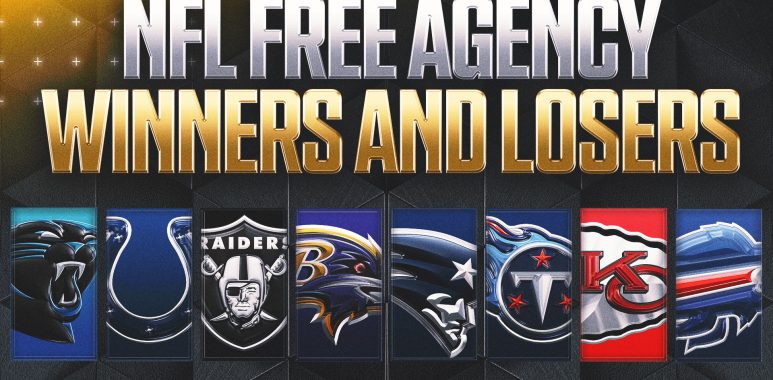
2026 NFL Free Agency: Winners and Losers Through the Early Wave
Disclaimer: This article was originally published on FOX Sports Digital. All articles, images, and related media on this website are sourced directly from their respective publishers and credited accordingly. TheRedZone.org does not claim ownership of any third-party content and provides it solely for informational and news aggregation purposes. All rights to original materials remain with their respective copyright holders.
With the 2026 league year underway, the flurry of NFL free-agent deals and trades we’ve seen over the past several days are now official. One huge trade, of course, didn’t quite make it to the new league year. We’ll get into that in detail. So who are the big winners to this point? And which teams are worse off? In descending order, here are my top four winners and losers through the early wave of free agency: Winners 4. Carolina Panthers The Panthers surprised the NFL world by reaching the playoffs last season, and now they’ve added big-time help to what was an average defense. Former Jaguars All-Pro Devin Lloyd (three years, $45 million) was one of the top off-ball linebackers available in free agency, and ex-Eagles edge Jaelan Phillips (four years, $120 million) was one of the top pass rushers on the market. Carolina also added Kenny Pickett as a backup behind fourth-year quarterback Bryce Young. The Panthers are positioned to take another leap forward in 2026. 3. Tennessee Titans The Titans took full advantage of their more than $90 million in cap space at the start of the offseason, investing heavily in starters such as wide receiver Wan’Dale Robinson (four years, $78 million), defensive lineman John Franklin-Myers (three years, $63 million) and cornerbacks Alontae Taylor (three years, $60 million) and Cor’Dale Flott (three years, $45 million). Spending big in free agency doesn’t guarantee success, but if done the right way with a quarterback on a rookie contract, it can thrust a team into contention quickly. Just look at QB Drake Maye and the Patriots, who made the Super Bowl last season after winning four games in 2024. And the Titans were intentional in adding players that coach Robert Saleh and offensive coordinator Brian Daboll know well from past stops. On paper, Saleh now has a competent defense to work with in his first year as Titans head coach. 2. Baltimore Ravens The perception of the Ravens took a hit for backing out of their proposed trade for Raiders edge Maxx Crosby, as evident by what league executives told our Eric D. Williams and Ralph Vacchiano. But Baltimore is undoubtedly a better team moving forward. General manager Eric DeCosta said Wednesday that he was interested in pairing Crosby with Trey Hendrickson. In the end, the Ravens came away with the former Bengals edge (four years, $112 million) — a four-time Pro Bowler — and retained the first-round picks in 2026 and ‘27 they would’ve lost in the Crosby deal. 1. New England Patriots The reigning AFC-champion Patriots added long-term upside at wide receiver with Romeo Doubs (four years, $80 million), who’s seven years younger than Stefon Diggs (released last week). Worst case scenario, Doubs is a No. 2 option for third-year QB Drake Maye. The Pats got much-needed offensive line help in Alijah Vera-Tucker (three years, $42 million), too. They’re taking on some risk in Vera-Tucker — the former first-round pick missed all of last season with a torn triceps — but he was a Pro Bowl-caliber guard for the Jets when healthy, so he could wind up as a major steal. New England also shored up its starting defense with former Bears safety Kevin Byard (one year, $8 million), the NFL’s interception leader last season, and veteran pass-rusher Dre’Mont Jones (three years, $39.5 million), who had seven sacks in 2025. Losers 4. Buffalo Bills By trading for DJ Moore, the Bills nabbed a much-needed No. 1 option for star QB Josh Allen. But the cost to acquire the veteran wide receiver was steep: Buffalo gave Chicago a 2026 second-round pick, and guaranteed $15.5 million of Moore’s 2028 salary as part of the trade. That means the Bills are on the hook for $62.5 million in guarantees for the 28-year-old Moore over the next three seasons, including $47 million fully guaranteed through 2027. 3. Kansas City Chiefs Adding Super Bowl LX MVP Kenneth Walker III (three years, $53.05 million) gives the Chiefs a dynamic option at running back, but their defense faces major questions after losing three cornerbacks, including All-Pro Trent McDuffie (trade) and fellow starter Jaylen Watson (free agency) to the Rams. The Chiefs have a dwindling window of opportunity with 36-year-old tight end Travis Kelce returning for a 14th season and 31-year-old left tackle Chris Jones. So a team that missed the playoffs last season looks worse off at the moment, though that outlook could change with the draft next month. 2. Indianapolis Colts The Colts needed to retain both quarterback Daniel Jones and wide receiver Alec Pierce, but it looks like they’ve overpaid in order to do so. Indianapolis got just 10 games of elite play from Jones, who’s recovering from a torn Achilles, and are now giving him the largest two-year deal in NFL history, including $50 million fully guaranteed at signing. Sam Darnold got just $37.5 million fully guaranteed at signing a year ago from the Seahawks after a 14-win, Pro Bowl season with the Vikings. Indy gave Pierce a deal worth $28.5 million in average annual value. He would’ve been significantly cheaper had the team extended him after the 2024 season, when he had just over 800 receiving yards. The former second-round pick would’ve been cheaper if a contract had been hammered out earlier this offseason, too, before it became clear that he’d be the top free-agent wide receiver. 1. Las Vegas Raiders We don’t yet know the full ramifications of the Ravens’ decision to pull out of the Maxx Crosby trade. Even if Crosby’s contract (four years and $115.8 million remaining) doesn’t impact the Raiders’ ability to absorb all their free-agent deals, which total more than a quarter-billion dollars in total value, their financial flexibility is still impacted. The franchise had also been operating on the assumption that it would have Baltimore’s first-round picks in 2026 and ‘27, including No. 14 overall this year. That could have massive ramifications on the Raiders’ roster-building approach.


