

10 NFL Icons Who Quit Football for Wild New Careers
This article was originally published on Total Pro Sports.

We’re diving into something totally off the gridiron: 10 NFL Icons Who Quit Football for Wild New Careers. These aren’t your typical retirees sliding into coaching gigs or analyst booths—these guys hung up their cleats and leapt into completely unexpected worlds, from high-stakes military ops to brain surgery, wrestling rings, and even Pokémon empires.
Whether driven by passion, tragedy, or just a craving for change, their post-NFL lives are as epic as their highlight reels.
The NFL chews up talent fast, with careers averaging just 3.3 years, but these icons didn’t fade away—they reinvented themselves in ways that shocked fans and inspired headlines. We’ll count them down from 10 to 1, exploring their gridiron glory, the pivot points, and how they’re thriving (or remembered) in their bizarre new chapters.
Some chased dreams deferred, others answered higher callings, but all proved there’s life beyond the end zone.
Which NFL icons had different careers after quitting football?
10. Ta’u Pupu’a – From Lineman to Opera Singer

Kicking off our list is Ta’u Pupu’a, the massive offensive lineman whose NFL dreams gave way to a voice that could fill opera houses. Undrafted out of Weber State in 2015, Pupu’a signed with the Baltimore Ravens as a guard, bringing his 6’6″, 320-pound frame to protect quarterbacks.
He spent time on practice squads for the Ravens and later the New York Giants, but injuries and roster cuts kept him from cracking the starting lineup. In two years, he appeared in just a handful of preseason games, showcasing solid pass-blocking but never getting a full shot in the regular season.
Frustrated by the grind and a lingering shoulder injury from college, Pupu’a retired quietly in 2017 at age 25, deciding to pursue a hidden talent: opera singing. Born in Tonga and raised in Utah, he’d always had a powerful tenor voice, honed in church choirs and high school musicals.
Post-NFL, he enrolled at the University of Utah’s music program, earning a degree in vocal performance. By 2019, Pupu’a was performing professionally, landing roles in operas like “The Marriage of Figaro” and touring with symphony orchestras. He’s released albums blending Polynesian folk with classical arias and even performed at NFL events as a nod to his past.
Fans call him the “Singing Giant,” and his story is a reminder that sometimes the wildest pivot is following your inner voice—literally. From blocking blitzes to belting high Cs in the NFL, Pupu’a’s career switch is pure inspiration.
9. Glen Coffee – From Running Back to Army Paratrooper

At number nine, Glen Coffee, the San Francisco 49ers running back, traded touchdowns for tactical jumps. A third-round pick out of Alabama in 2009, Coffee backed up Frank Gore as a rookie, rushing for 226 yards and two scores in 14 games, averaging a solid 3.3 yards per carry. His speed and vision hinted at starter potential, and coaches praised his work ethic during a 49ers rebuild.
But after one season, Coffee stunned everyone by retiring at 23 in 2010, citing a spiritual calling to serve in the military. No injuries forced his hand—it was a personal epiphany during offseason Bible study. He enlisted in the U.S. Army, completing Ranger School and becoming a paratrooper with the 6th Ranger Training Battalion.
Coffee deployed overseas, earning commendations for leadership in high-risk operations. By 2017, he’d left active duty but attempted an NFL comeback with the 49ers, who still held his rights—only to fail due to roster depth.
Now in his 30s, Coffee works as a youth mentor and author, penning books like “There’s More to Life Than the Pursuit of Money.” His wild career switch from end-zone glory to airborne assaults embodies sacrifice, making him a hero beyond the NFL field.
8. John Urschel – From Offensive Lineman to Mathematician

Number eight is John Urschel, the Baltimore Ravens guard whose brainpower outshone his blocking. A fifth-round pick out of Penn State in 2014, Urschel started 13 games over three seasons, helping protect Joe Flacco during a playoff run. He earned praise for his technique and intelligence, holding down the line with a physics-like precision, fitting, since he published math papers while playing.
Concussions and CTE fears led Urschel to retire abruptly in 2017 at 26, just days after a landmark brain study on football players. He dove headfirst into academia, earning a PhD in mathematics from MIT while focusing on spectral graph theory and machine learning.
Now a professor at MIT, Urschel authors books like “Mind and Matter: A Life in Math and Football” and lectures worldwide on algorithms. He’s consulted for tech firms and even competed in high-stakes chess tournaments. Urschel’s pivot from pancaking defenders to proving theorems is wildly intellectual, proving NFL brawn can hide world-class brains.
7. Blake Martinez – From Linebacker to Pokémon Card Mogul

Sliding into seven is Blake Martinez, the tackling machine who swapped sacks for shiny cards. A fourth-round pick by the Green Bay Packers in 2016 out of Stanford, Martinez racked up over 500 tackles in four seasons, leading the NFL with 144 in 2017. He signed a $30 million deal with the New York Giants in 2020, adding 151 tackles before an ACL tear in 2021 sidelined him.
During rehab, Martinez discovered a passion for Pokémon trading cards, investing in rare sets. He retired mid-2022 and left his NFL career at 28 to launch Blakes Breaks, a company reselling high-end cards. By 2023, he’d grossed over $5 million, flipping gems like a $100,000 Charizard.
Martinez hosts live breaks on social media, building a collector empire. His wild switch from defensive calls to card deals shows how hobbies can become multimillion-dollar hustles— a geeky, lucrative leap from the league.
6. Charles ‘Peanut’ Tillman – From Cornerback to FBI Agent

At number six, Charles Tillman, the Chicago Bears’ shutdown corner, whose picks turned into busts of criminals. A second-round pick out of Louisiana-Lafayette in 2003, Tillman earned two Pro Bowls over 13 seasons, forcing 44 fumbles (an NFL record) and snagging 38 interceptions. His “Peanut Punch” technique revolutionised takeaways, helping the Bears to a Super Bowl appearance.
Retiring in 2016 at 35 after injuries, Tillman pursued a criminal justice degree and joined the FBI in 2018 as a special agent. He underwent rigorous training, including firearms and surveillance, and now works on undercover cases, from cybercrime to counterterrorism. But he left it all in 2026.
Tillman also rows across Lake Michigan for charity, raising funds for pediatric cancer. His transition from intercepting passes to nabbing bad guys is wildly heroic, blending gridiron grit with badge-bearing bravery.
5. Myron Rolle – From Safety to Neurosurgeon

Halfway through, number five: Myron Rolle, the Tennessee Titans safety who traded tackles for transplants. A sixth-round pick out of Florida State in 2010, Rolle played sparingly in two seasons, logging time on special teams but never cracking the defense due to depth.
A Rhodes Scholar, Rolle deferred the NFL for Oxford studies in medical anthropology. After a brief NFL career, he retired in 2013 at 26 to attend Florida State Medical School. Now a neurosurgeon at Massachusetts General Hospital, Rolle specialises in pediatric brain surgery, performing life-saving operations.
He’s authored papers on global health and founded a foundation aiding underserved communities. Rolle’s pivot from safety blitzes to scalpel precision is wildly impactful, saving lives where he once chased quarterbacks.
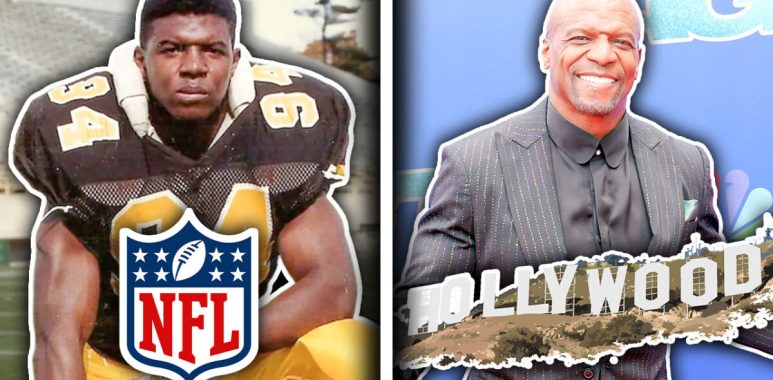
4. Terry Crews – From Defensive End to Hollywood Star

Number four: Terry Crews, the journeyman defender who became a blockbuster icon. Drafted by the Los Angeles Rams in 1991 out of Western Michigan, Crews bounced between the Rams, Chargers, Redskins, and Eagles over six seasons, appearing in 32 games with modest stats like three sacks.
Retiring in 1997 at 29 due to limited opportunities, Crews pursued acting, breaking out in “Friday After Next” and starring in hits like “White Chicks,” “Brooklyn Nine-Nine,” and the “Expendables” series. He’s hosted “America’s Got Talent,” authored self-help books, and advocated for #MeToo. Crews’ wild leap from pass rushes to career punchlines turned him into a cultural force, proving NFL grit fuels Tinseltown triumphs.
3. Bill Goldberg – From Defensive Tackle to Wrestling Legend

Bronze medal: Bill Goldberg, the Atlanta Falcons powerhouse who speared his way to WWE fame. Undrafted out of Georgia in 1990, Goldberg played for the Falcons from 1992-1994, recording 11 tackles in 14 games before injuries ended his stint.
Retiring in 1995 at 28 after a torn abdominal muscle, Goldberg trained in wrestling, debuting in WCW and becoming a champion with his undefeated streak. He’s won WWE titles, acted in films like “The Longest Yard,” and returned to the ring sporadically. Goldberg’s switch from defensive stops to suplexes built a $20 million empire, a wildly physical reinvention.
2. Alan Page – From Defensive Tackle to Supreme Court Justice

Runner-up: Alan Page, the Minnesota Vikings Hall of Famer who ruled from the line to the bench. A first-round pick out of Notre Dame in 1967, Page earned NFL MVP in 1971, nine Pro Bowls, and helped the Purple People Eaters to four Super Bowl appearances, amassing 148.5 sacks.
Retiring in 1981 at 36, Page, who earned a law degree after his NFL career, became Minnesota’s Assistant Attorney General, then a Supreme Court Justice from 1993 to 2015. He championed education reform and founded the Page Education Foundation. Page’s pivot from quarterback crushes to legal precedents is wildly profound, blending brute force with judicial wisdom.
1. Pat Tillman – From Safety to Army Ranger

Topping the list: Pat Tillman, the Arizona Cardinals star who left stardom for ultimate sacrifice. A seventh-round pick out of Arizona State in 1998, Tillman earned a starting spot, recording 381 tackles and 2.5 sacks over four seasons, including a franchise-record 155 tackles in 2000.
Shaken by 9/11, Tillman enlisted in the Army in 2002 at 25, turning down a $3.6 million contract. He became a Ranger, deploying to Iraq and Afghanistan, where he was killed by friendly fire in 2004. Tillman’s foundation aids veterans. But his wild, tragic switch from intercepts to infantry defines patriotism and purpose beyond football.


