

10 NFL Players You Forgot Played for These Teams
This article was originally published on Total Pro Sports.

When you think of NFL greats who had memorable stints with not one, but two teams? Guys like Tom Brady, Drew Brees, and Peyton Manning come to mind.
But not all NFL greats flourished after changing teams late in their careers. They looked naturally out of place in a specific jersey, and probably wish to remove all memories of that club.
With that, here are 10 NFL greats who played for surprisingly strange teams.
Which star NFL players played for an unusual team?
Jerry Rice: Seattle Seahawks

The greatest wide receiver and non-quarterback player in NFL history spent his first 16 seasons with the NFL’s golden franchise, the San Francisco 49ers. The 49ers, having already won two Super Bowls under Bill Walsh and Joe Montana, got even richer after drafting Rice 16th overall in 1985.
Rice became the new face of the 49ers’ franchise from there, propelling them to three Super Bowl championships during his Hall of Fame career. But with the 49ers’ glory days in the past, and fellow future Hall of Famer Terrell Owens taking over as their new No. 1 receiver, the front office made the painful decision to cut Rice after 16 years.
To his credit, Rice had a nice career revival with the Oakland Raiders. He had to 1,000-yard seasons there and led them to a Super Bowl 37 appearance, where they fell to the Tampa Bay Buccaneers.
The Raiders were a fine second act for Rice. But when he was traded to the Seahawks during the 2004 season? It just felt very weird from the beginning.
We know, we know. The Seahawks are a relevant and well-respected NFL franchise. Four NFC titles and two Super Bowl championship banners were won over a 20-year period between 2005 and 2025.
But you kids have to picture what the Seahawks were like before 2005. Before that season, they hadn’t won a playoff game since 1984. And their fortunes didn’t begin to change until 2002, when NFL realignment shifted the Seahawks to the NFC, making room for the expansion Houston Texans’ franchise to become the AFC’s 16th team.
So yes, it was very, very weird when Rice landed with the Seahawks. The NFL’s GOAT at the time just never looked comfortable there. He caught 25 passes for 362 yards and three touchdowns as a Seahawk, retiring after the 2004 season.
Emmitt Smith: Arizona Cardinals

Ask any NFL fan born in the 21st century if they know who Emmitt Smith played his final two seasons with? Can’t blame the ones if they go with the Dallas Cowboys. We’d guess less than 10 percent would correctly guess the Cardinals.
The NFL’s all-time rushing yards and rushing touchdowns leader was the backbone of the Cowboys’ ‘90s dynasty that won three Super Bowls over a four-year period between 1992 and 1995.
The four-time rushing champion played his first 13 NFL seasons on America’s Team from 1990 to 2002. In his final season with the Cowboys, Smith rushed for 975 yards and five touchdowns — falling short of the 1K mark for the first time since his rookie year.
Knowing Smith’s best days were behind him, the Cowboys made the difficult decision to release him in 2003. Smith wasn’t on the open market for long, as the Cardinals unexpectedly scooped him up on a two-year deal.
Smith’s first year with the Cardinals was hampered by injuries. But in his swan song 2004 campaign, the NFL’s rushing kind showed some of that old juice again with 937 rushing yards and nine touchdowns.
It’s been more than two decades since Smith played his final NFL snap. And to this day, seeing him in a Cardinals jersey still just doesn’t seem right.
Johnny Unitas: San Diego Chargers

Long before the likes of Joe Montana, Peyton Manning, Tom Brady, and Aaron Rodgers arrived, Unitas held the title as the greatest quarterback in NFL history.
After a failed tryout with the Pittsburgh Steelers in 1955, Unitas joined the Baltimore Colts in 1956. The following year, Unitas earned his first of 10 Pro Bowl selections after leading the NFL in passing yards and passing touchdowns.
“The Golden Arm” became the NFL’s best quarterback from there. He won three MVP awards and led the Colts to NFL championships in 1958, 1959, and 1968.
Unitas also led the Colts to their first Lombardi Trophy, defeating the Dallas Cowboys in Super Bowl V. But in that game, Unitas was knocked out with a rib injury and replaced by Earl Morrall.
That put the wheels in motion for Morrall to take over as the starter in the ensuing 1971 season. Unitas was demoted to backup over his final two years in Baltimore. In 1973, he was traded to the San Diego Chargers.
Unitas in a Bolts uniform looked bizarre and wrong from the beginning. He went from the face of one of the NFL’s golden franchises to an irrelevant Chargers team. To make matters worse, he was clearly a shell of his former self in 1973, completing 44.7 percent of pass attempts for three touchdowns and seven interceptions.
Eventually, the struggling Chargers handed the starting duties to a future Hall of Famer named Dan Fouts. And the rest, as they say, is history.
Ed Reed: New York Jets

Arguably the greatest safety in NFL history, Reed finally reached the mountaintop when his Ravens defeated the 49ers in Super Bowl 47. After winning it all, the Ravens decided to begin a drastic roster overhaul.
Franchise GOAT Ray Lewis retired. Anquan Boldin was traded to San Fran. Reed wasn’t retained in free agency, and he wound up signing with the Houston Texans for $15 million over three years.
After seven games, Reed was waived by the tanking Texans. Rex Ryan’s Jets claimed Reed off waivers, launching one of the most random pairings in NFL history. Reed finished strong, recording three interceptions and four pass breakups in seven games with the Jets. He retired after the season.
Still, images of Reed in a Jets jersey will always be ultra-weird to us. Like, Pete-Davidson-dating-Kim-Kardashian-weird.
Terrell Owens: Buffalo Bills

T.O. played for five NFL teams in his Hall of Fame career. Everyone knows about his storied eight-year tenure with the 49ers.
And his rocky two-year tenure with the Philadelphia Eagles. And for better or worse, nobody forgot about those three years Owens spent with Tony Romo and the Dallas Cowboys. That’s his quarterback!
And because his one-year stop with Chad Johnson’s Cincinnati Bengals was such a hysterical flop…it’s hard to forget the photos of T.O. in the black and orange.
But the Buffalo Bills? He played there in 2009? Arguably, the best wide receiver of the 2000s really played for one of the NFL’s most dysfunctional franchises. Who was their coach? Who was the quarterback? Can anyone even name another player on those ‘09 Bills?
Yeah, it’s true. In his penultimate season, Owens caught 55 passes for 829 yards and five touchdowns. Not bad for a 36-year-old who was stuck on such a bad Buffalo team! But not as bad as his decision off the field in 2021.
Adrian Peterson: Detroit Lions

In a way, it’s hard to believe that an all-time great running back like Peterson played for seven NFL teams. I mean, the aforementioned Emmitt Smith only played for two teams.
Barry Sanders was a career Lion. Walter Payton only wore a Chicago Bears uniform. Jim Brown only played for the Cleveland Browns. You get the idea by now.
Peterson spent his first 10 seasons with the Minnesota Vikings, of course. And fans, unfortunately, remember his first post-Vikings season in 2017, which was split with the Arizona Cardinals and New Orleans Saints.
And we remember his two bounce-back campaigns in Washington…and AP splitting his final season with the Seahawks and Titans in 2021. But this dude played for the Lions in 2020? On what planet? Our planet? Oh, okay.
AP signed a one-year deal with the Lions ahead of the 2020 season. Even though they were a mess that year, a 35-year-old Peterson still rushed for 604 yards and seven touchdowns. However, off-field issues have plagued him since then.
Darrelle Revis: Kansas City Chiefs

Revis spent eight of his 11 seasons with the Jets, where he carved out a Hall of Fame career. Between his two Jets tenures were one-year stints with the Tampa Bay Buccaneers — cough, forgettable — and the New England Patriots. Jackpot!
Revis won his only Super Bowl ring with the Patriots in the 2014 season. After winning it all, Revis returned to the Jets on a multi-year deal in 2015 free agency.
Revis’ second stint with the Jets only lasted two years, however. He was released after a dismal 2016 season that saw him get lit up in coverage time and time again. The seven-time Pro Bowler went unsigned through the offseason before the desperate Chiefs signed him to a two-year deal midway through the 2017 campaign.
Revis played just five games with KC and was clearly well past his best-before date. He was released after the Chiefs’ Wild Card Round loss to the Titans and retired soon after.
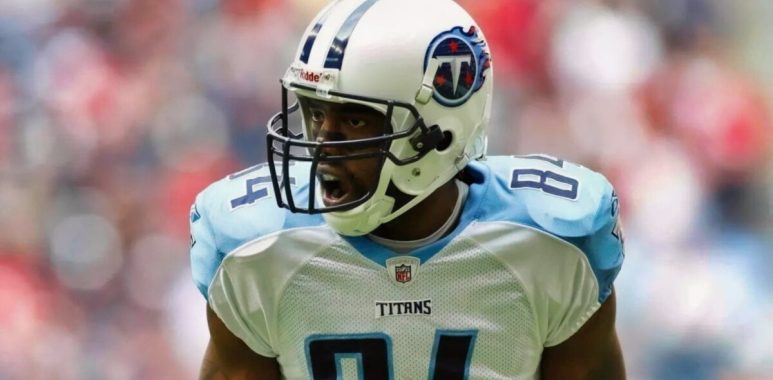
Randy Moss: Tennessee Titans

Minnesota Vikings fans fondly remember Moss and his first seven seasons with the club. His second go with the Vikings in 2010? Don’t worry about it.
Everyone knows about his somewhat short but sweet three seasons and a bit with the New England Patriots. And who can’t forget Moss and his two years with the Oakland Raiders? It wasn’t great by any means, but certainly hard to forget.
And you 49ers fans obviously recall his one-year stint on the West Coast — one that nearly led to a Super Bowl 47 triumph. Of course, John Harbaugh’s Baltimore Ravens had other ideas.
But Moss is briefly playing for the Tennessee Titans of all NFL teams? That’s as random as it gets. And yes, it actually did happen.
The Patriots traded Moss back to Minnesota early in the 2010 season. After a disappointing stint there, he was waived and picked up by the Titans. He caught six passes for 80 yards and no touchdowns. Ho hum.
Not that he was lights-out when he returned to play for the 49ers in 2012. But at least Moss made the odd big play and went to a Super Bowl!
Deion Sanders: Baltimore Ravens

Sanders is one of the rare legendary athletes who is synonymous with not one, not two, but three (!) NFL teams. Kind of like LeBron James…
King James is synonymous with the Los Angeles Lakers, Miami Heat, and Cleveland Cavaliers. “Prime Time” is best remembered for his storied tenures with the Atlanta Falcons, San Francisco 49ers, and Dallas Cowboys.
Sanders spent his first five seasons in Atlanta. Then he joined the 49ers in 1994 free agency, won his first Super Bowl, and then signed with the Cowboys in 1995. Sanders won his second ring that year and would stay with America’s Team through the 1999 season.
Now, some of you might remember that Sanders spent one season with Washington in 2000. But after completing just one season of the seven-year, $56 million deal he signed in free agency, Prime Time retired. And so was the end of a storied career.
Or not.
After three years away from football, Sanders un-retired to join the Baltimore Ravens in 2004. As great as Ray Lewis and Ed Reed were in those Ravens uniforms? Man, did Sanders look more out of place than Adam Banks when he was briefly on the Varsity Team in “D3: The Mighty Ducks.”
Sanders had two underwhelming campaigns in Baltimore before retiring permanently after the 2005 season. He’s now coaching Colorado and making headlines again.
Joe Namath: Los Angeles Rams

Some Hall of Fame quarterbacks just never knew when it was time to retire. We already talked about Johnny Unitas. And y’all remember the Brett Favre on-again/off-again retirement-unretirement-retirement circus.
But among these three, nobody failed to read the writing on the wall worse than Joe Namath. It doesn’t take away his remarkable contributions to the New York Jets’ franchise. But man, the story would have been a lot nicer if he spent his entire career in a Jets uniform.
The No. 1 pick of the 1965 AFL Draft completely changed the dynamic of the Jets franchise, leading them to a Super Bowl 3 victory over the heavily favored Baltimore Colts. That one game alone cemented Broadway Joe’s status as a New York icon.
Unfortunately, injuries and inconsistent production derailed Namath’s last two seasons with the Jets. He was waived in 1977 and was picked up by the Los Angeles Rams
Namath had next to nothing left in that arm, though. He completed less than 50 percent of pass attempts and had three touchdowns against five interceptions. The Rams saw enough and benched him for Pat Haden, who rallied them to the postseason.
Namath finally retired after the 1977 season, but not before the one forgettable and totally random stint with LA.


