

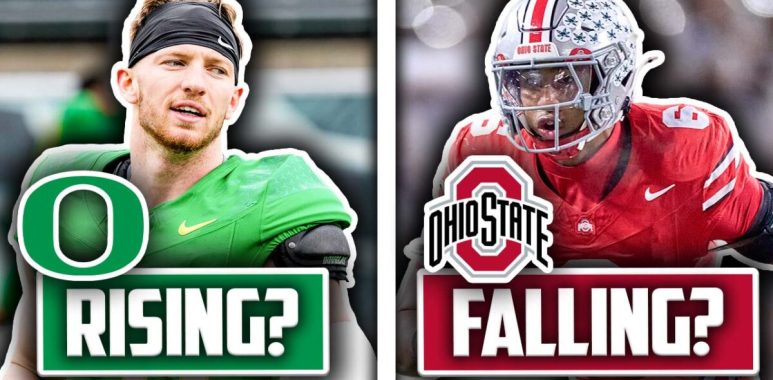
6 Players Whose 2026 NFL Draft Stock Are Rising And 6 Who Are Falling Fast After The Combine
This article was originally published on Total Pro Sports.

The NFL Combine is supposed to provide clarity, but more often than not, what it actually delivers is chaos.
The media seems to forget that football is actually played on the field, with 40-yard dash times and vertical jumps getting obsessed over.
Quarterbacks get their hands measured and scrutinized to the highest degree.
And somewhere in the middle of it all, a guy who was projected to go in the teens suddenly finds himself in top-10 conversations while a sure-fire first-rounder starts sliding down draft boards.
That’s the Combine. It creates as many questions as it answers.
So let’s break down six prospects who helped themselves and six who… didn’t.
Which prospects stood out or faltered in the NFL Combine?
RISING: Sonny Styles, LB, Ohio State

If you watched the NFL Combine and didn’t come away thinking Sonny Styles is a top-10 pick, you weren’t paying attention.
The Ohio State linebacker put together one of the most absurd athletic testing profiles we’ve seen in years. At 6-foot-5 and 244 pounds, Styles ran a 4.46-second 40-yard dash, posted a 43.5-inch vertical jump—the highest by any player over 6-foot-4 and 240-plus pounds since at least 2003.
And for good measure, he topped that off with an 11-foot-2 broad jump.
The guy is an athletic freak in every sense of the word.
Let’s put that in perspective: He’s taller than Mike Evans, faster than George Pickens, jumps higher than Davante Adams, and is more explosive than Derwin James Jr.
That’s not a linebacker testing profile. That’s a create-a-player from Madden.
Before the Combine, Styles was a fringe top-10 pick. Now? He might be the first defender off the board.
And keep in mind, Styles has only been playing linebacker for two years. He started his college career as a safety before transitioning to off-ball linebacker in 2024. And despite the position switch, he still put up big numbers at Ohio State.
FALLING: Malachi Fields, WR, Notre Dame

Malachi Fields walked into Indianapolis with momentum, but scouts left with questions.
The Notre Dame receiver had a strong Senior Bowl showing in Mobile, flashing the contested-catch ability and body control that made him a popular sleeper pick heading into the pre-draft process. He’s a big-bodied receiver who wins at the catch point—the kind of player who makes difficult grabs look routine.
But the Combine exposed the concern that’s followed him throughout his college career: Can he separate?
Fields ran a 4.61-second 40-yard dash, the second slowest time among all receivers who participated. For a guy who already sat in just the 13th percentile in separation percentage against single coverage over the past three seasons, that number is a red flag.
That archetype—the big receiver who wins with body control rather than speed—can work in the NFL. But it requires a very specific role and a quarterback willing to throw into tight windows. Not every team wants to build around that.
RISING: Dillon Thieneman, S, Oregon

If you weren’t familiar with Dillon Thieneman before the NFL Combine, you are now.
The Oregon safety absolutely destroyed his testing. He ran a 4.35-second 40-yard dash with a 1.52-second 10-yard split at 6-foot and 201 pounds. He posted a 41-inch vertical jump. He hit a 10-foot-5 broad jump. And then he went out and looked smooth and fluid in every single drill.
This is the kind of testing profile that moves guys from “yeah, he’s pretty good” to “we need to trade up to get him.”
Thieneman spent his first two seasons at Purdue, where he was an All-American as a true freshman after racking up six interceptions in 2023. He transferred to Oregon for 2025 and was immediately one of the best safeties in the country, posting 92 tackles and two interceptions while helping the Ducks rank fourth nationally in passing yards allowed.
The Harrison Smith comparisons are everywhere now—probably because they have a… uh… similar build. Yeah—that and their versatility! Guys that can play single-high, disguise coverages, and come down to make plays in the box.
FALLING: LT Overton, DL, Alabama

LT Overton entered the Combine needing to prove he belonged in the round 1 conversation, but he did the opposite.
The Alabama defensive lineman—who transferred from Texas A&M after two seasons—ran a 4.87-second 40-yard dash at 274 pounds with a sluggish 1.7-second 10-yard split. He opted not to participate in the vertical or broad jump, missing an opportunity to answer questions about his explosiveness. And his on-field drills showed exactly what scouts feared—stilted movement and marginal change-of-direction ability.
Here’s the issue with Overton: He’s a tweener. At 6-foot-3 and 274 pounds, he’s a little bulky to be an every-down edge rusher but a little light to be an interior three-technique. His best path to NFL success is probably as a defensive tackle who kicks inside on passing downs, but he hasn’t spent enough time doing that.
The tape at Alabama was solid, but unfortunately, the combine raised more questions than it answered about where he fits at the next level.
RISING: Kenyon Sadiq, TE, Oregon

Kenyon Sadiq didn’t just have a good NFL Combine. He had a historically great one. And he may go earlier compared to where he’s at in the current NFL mock drafts.
The Oregon tight end ran a 4.39-second 40-yard dash—the fastest official time by a tight end at the Combine, breaking the record Vernon Davis set back in 2006. Then he posted a 43.5-inch vertical jump, the second-best ever by a tight end. And an 11-foot-1 broad jump, the third-best ever at his position.
At 6-foot-3 and 241 pounds, Sadiq is running times that would be impressive for a receiver. He’s jumping like a defensive back. And he’s doing it all in a frame that can still line up inline and block.
The Combine transformed him from “best tight end in the class” to “potential mismatch nightmare who might not make it past pick 15.”
Teams that run RPO-heavy offenses with lots of motion and play-action are salivating right now. A tight end who can line up in the slot, outrun linebackers, and win contested catches against safeties? That’s the Travis Kelce blueprint. And Sadiq just proved he has the athletic tools to follow it.
FALLING: Davison Igbinosun, CB, Ohio State

Davison Igbinosun has the size NFL teams covet at cornerback. At 6-foot-2 with nearly 33-inch arms, he looks the part of a press-man corner who can disrupt receivers at the line and match up against bigger targets.
The problem is that his Combine testing didn’t match his measurements.
Igbinosun ran a 4.45-second 40-yard dash—respectable for a corner his size—, but his 34-inch vertical jump was the second-lowest among all cornerbacks who participated. His 10-foot broad jump was also near the bottom. His 1.58-second 10-yard split suggested a lack of the explosive first-step quickness teams want in their corners. And his on-field drills were concerning—stiff hips, stilted movement, and struggles finding and adjusting to the ball when challenged.
In a deep cornerback class, athleticism matters, and Igbinosun didn’t show the kind of twitch and fluidity that separates Day 1 corners from Day 2 guys.
RISING: Dani Dennis-Sutton, Edge, Penn State

Dani Dennis-Sutton was already viewed as one of the more polished edge defenders in this class. His NFL Combine performance just added a new dimension to his profile.
At 6-foot-6 and 256 pounds, Dennis-Sutton ran a 4.63-second 40-yard dash—impressive for a player his size. He posted a 39.5-inch vertical jump and a 10-foot-11 broad jump, both among the best marks for edge rushers. And then he did something almost no one expected: He ran a 6.90-second 3-cone drill, the best time among all defensive linemen at the Combine.
The Brian Burns comparison is floating around now. Both are long-limbed edge rushers who play with their hair on fire against the run and are still refining their pass-rush moves. Burns became a Pro Bowler. Dennis-Sutton has the tools to follow a similar path.
FALLING: Lee Hunter, DT, Texas Tech

Some guys aren’t built for the NFL Combine. Lee Hunter might be Exhibit A.
The Texas Tech nose tackle entered Indianapolis as a projected first-round pick based on his tape. He’s a 6-foot-3, 318-pound run-stuffer who clogs lanes and demands double teams. That’s valuable in the NFL.
But the testing? Yikes.
Hunter finished last—or close to it—among defensive tackles in virtually every measured event. His 21.5-inch vertical jump was a full six inches shorter than any other defensive tackle tested this year. That’s historically bad, even among the big guys who typically struggle in these settings.
But perception matters. And when a nose tackle posts testing numbers that make scouts question his explosion and movement ability, it creates doubt. Teams that were willing to spend a first-round pick on a two-down run-stuffer might now wait until the second round to grab him.
RISING: Jacob Rodriguez, LB, Texas Tech

Jacob Rodriguez entered the Combine as the most decorated linebacker in college football. He left it as one of the biggest winners of the week.
The Butkus Award winner from Texas Tech was viewed as a productive player with questions about his athleticism. At 6-foot-1 and 231 pounds, he’s undersized by NFL standards, and scouts wondered if his instincts would translate when the athletes around him got faster and stronger.
Indianapolis answered those questions emphatically, as Rodriguez ran a 4.57-second 40-yard dash, which was much faster than most expected.
Before the Combine, he was viewed as a Day 2 pick who might fall to the third round. Now? He’s firmly in the top-50 conversation and could sneak into the first round if a team falls in love with his playmaking ability.
FALLING: Emmett Johnson, RB, Nebraska

Emmett Johnson was supposed to be in the conversation for the second running back off the board behind Jeremiyah Love, but after his NFL Combine performance, that conversation just got a lot more crowded.
The Nebraska running back ran a 4.56-second 40-yard dash—the slowest time among all running backs who participated. At 202 pounds, Johnson isn’t a power back who can overcome pedestrian speed with size and strength. He needed to show burst and explosiveness to validate his tape.
He didn’t.
Johnson’s 35.5-inch vertical jump tied for sixth among backs, and his 10-foot broad jump was near the bottom of the group. His 7.32-second 3-cone drill was also disappointing, raising questions about his ability to make sharp cuts at the NFL level.
Here’s the thing: Johnson is still a talented player. He rushed for 1,451 yards and 12 touchdowns in 2025 while adding 46 catches for 370 receiving yards—the second-highest reception total by a running back in Nebraska history. He has vision. He has patience. He makes good decisions.
But running back is a position where athletic testing correlates heavily with NFL success. And Johnson’s numbers suggest he might lack the breakaway speed to be a featured back at the next level.
RISING: Mike Washington Jr., RB, Arkansas

The Arkansas back ran a 4.33-second 40-yard dash at the NFL Combine—the fastest time among all running backs in attendance. At 225 pounds, he was also the fastest player over 220 pounds at the entire event.
That’s a significant detail. Speed at his size is rare. And it changes the way teams view his NFL potential.
Washington followed up the 40 with a 39-inch vertical jump and a 10-foot-8 broad jump, confirming the explosiveness that showed up on his Arkansas tape. He’s a physical, downhill runner who can also take it to the house when he reaches the second level.
Before Indianapolis, Washington was viewed as a Day 2 back who might sneak into the second round if a team fell in love. Now? He’s firmly in the RB2 conversation and could challenge for a late first-round selection if a team gets desperate for a workhorse.
The size-speed combination is what sells. NFL teams are always looking for backs who can handle 20-plus carries a game. Washington just proved he has the physical tools to be that guy.
FALLING: Max Klare, TE, Ohio State

Max Klare was supposed to be one of the more polished pass-catching tight ends in this class. Instead, he left Indianapolis with more questions than answers… frankly, a continuation of his disappointing 2025 – 2026 campaign.
The Ohio State tight end chose not to run the 40-yard dash or participate in the vertical or broad jump. That’s his right—plenty of prospects save their testing for pro days. But in a deep tight end class, sitting out creates a narrative gap that other players are happy to fill. Especially after the season he had.
And then his on-field drills didn’t help. His ball skills looked average. His change of direction was unremarkable. His routes lacked the suddenness you want from a receiving-first tight end.
Klare’s production at Purdue in 2024 made him a coveted transfer portal addition for Ohio State, where he was expected to cement himself as a top draft pick, but at this point, his prospects are looking quite bleak.


