

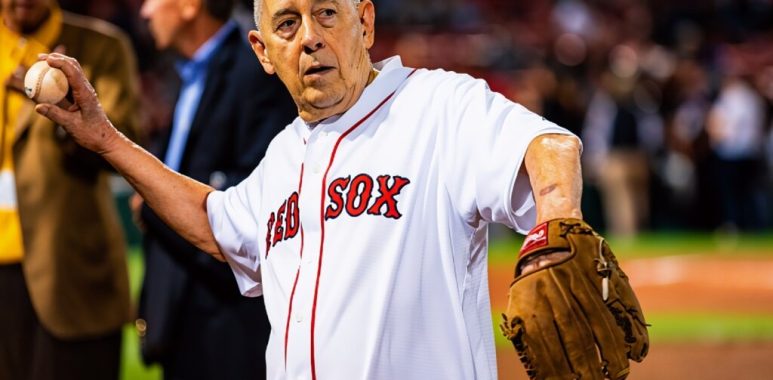
Bill Rasmussen, The Man Who Founded ESPN, Has Died At 93
This article was originally published on Total Pro Sports.

Bill Rasmussen, the man who dreamed up round-the-clock sports television and turned that idea into ESPN, has died at 93. The network paid tribute to him live on First Take shortly after announcing his passing.
Rasmussen died at his Florida home from the effects of Parkinson’s disease, a condition he had lived with since his diagnosis in 2014.
He first went public with the news in 2019, using the moment to encourage others facing the same disease. ESPN historian Mike Soltys confirmed the cause of death.
“Bill was a remarkable man — a visionary and an innovator who conceived the idea of a network entirely devoted to sports,” network Chairman Jimmy Pitaro said.
“Quite simply, none of us would be here today if it wasn’t for Bill’s passion and all the hard work and entrepreneurial spirit he put into building ESPN in the late 1970s — key aspects of our company culture that still carry on to this day,” Pitaro added.
An Idea Borne Out Of A Firing

Rasmussen’s path to ESPN started with a layoff. He lost his job as communications director for the New England Whalers in 1978, and rather than look for another job in hockey, he began chasing a much bigger idea.
Working alongside his son, Scott, Rasmussen envisioned a channel devoted entirely to sports, running all day and all night. He maxed out a credit card and used a $9,000 advance to secure space on a communications satellite, a gamble that eventually became the foundation of ESPN.
“I thought, why not a channel that’s on all the time?” Rasmussen said years later. “Sports don’t stop at six o’clock.”
ESPN launched at 7 p.m. on Sept. 7, 1979, debuting with the first episode of “SportsCenter” from its headquarters in Bristol, Connecticut.
Six months before that launch, Rasmussen and his founding team had already sold 85% of the fledgling company to Getty Oil, a decision that ultimately cost him control. He was pushed out of the network just a year after ESPN’s first broadcast.
A Rift That Eventually Healed Nearly Two Decades Later

Rasmussen’s relationship with ESPN stayed distant for 19 years. That changed when then-president George Bodenheimer reached out ahead of the network’s 20th anniversary, bringing Rasmussen back into the fold as a celebrated founding figure.
This past spring, ESPN released a documentary and a companion book, “Sports Heaven: The Birth of ESPN,” based on his firsthand account of the network’s earliest days.
Rasmussen’s legacy continues to show up in ESPN’s ongoing changes, from new programming decisions to recent departures like longtime “SportsCenter” anchor Linda Cohn’s exit after more than 5,500 episodes, a reminder of just how much the network he built has evolved since 1979.
Rasmussen was born in Chicago in 1932 and served in the U.S. Air Force before beginning his media career at radio stations in Massachusetts in the 1960s.
He was inducted into the Sports Broadcasting Hall of Fame in 2025, one of the final honors in a career that fundamentally changed how the world watches sports.
We at TPS extend our sincere condolences to his family and loved ones.


