

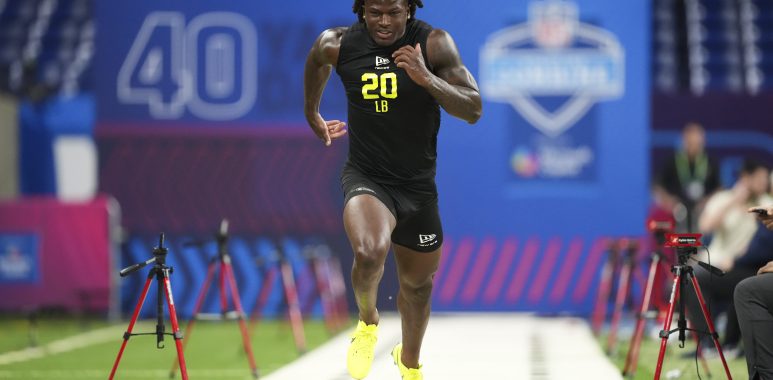
Why Is It A 40-Yard Dash, And Not 50 Or 100 Yards? Here’s The Shocking Reason That Nobody Knows About
This article was originally published on Total Pro Sports.

There aren’t many drills as hyped as the 40-yard dash when the NFL Scouting Combine comes around. But it wouldn’t come as a surprise if you were unaware of the origin.
While it’s often treated as a spectacle and a rudimentary speed trial, the 40-yard dash, which dates back to the 1980s, is more specific than meets the eye.
Coaches and scouts were looking for a standardized way to evaluate prospects after the NFL brought separate team workouts under a large umbrella, originally called the National Invitational Camp and now the Scouting Combine.
Speed was, of course, one of the most important factors.
But why 40 yards? That’s because it was around the average sprint on a punt play, with players covering at least 40 yards before contact. So the distance was introduced as a way to record game-speed acceleration, not just sprinting.
Paul Brown, a former Cleveland Browns head coach who later founded the Cincinnati Bengals, chose the distance.
The story surfaced on social media after the latest combine.
“Paul Brown estimated that on average, a punt travels from foot to a receiver’s hand about 40 yards in about 4.5 seconds,” an X user noted.
He added:
“It’s a punt gunner drill. Gil Brandt took it from him, and when the first ever scouts went to find talent: that is what they were looking for. When we opened the combine in 1982, we made these kids run the 40 to standardize the test.”
The 40-Yard Dash Has Come A Long Way Over A Short Distance

Scouts initially timed the dash with stopwatches as prospects crossed the line. While it wasn’t a foolproof method, it was what was available at the time. Nowadays, it’s all done electronically, leaving little doubt.
The dash became a staple at the Combine by the late ‘80s as television networks turned it into a spectacle.
One GM was even caught trash-talking a wide receiver over his time last week.
It’s usually the first thing NFL fans want to know about incoming players. One GM was even caught trash-talking a wide receiver over his time last week.
The drill is also a subject of much debate, with some arguing that it’s overhyped while others believe it’s a true indicator of a player’s value.
As you would know, countless superstars have gone on to prove the latter wrong.


