

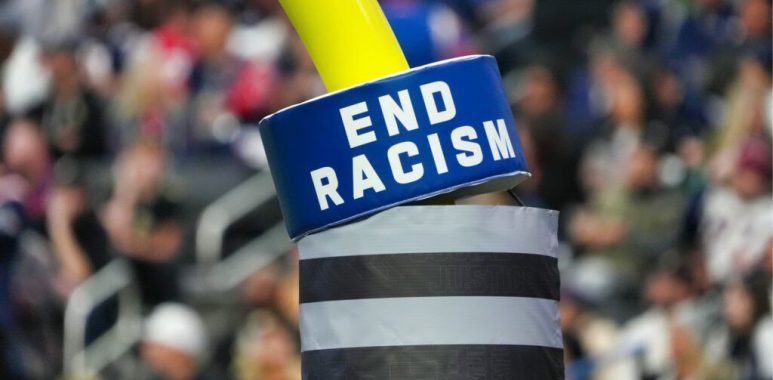
NFL Announces Major Decision Regarding “End Racism” Messages On The Field For 2026 Season
This article was originally published on Total Pro Sports.

Ten years have passed since a 49ers quarterback refused to acknowledge the national anthem. That single moment still determines some of what fans see on NFL fields today.
This week, the NFL confirmed to Front Office Sports that it will again place anti-racism messaging across playing fields and player helmets in 2026.
It marks the seventh straight season the NFL has run some version of this program.
“Can confirm that we are continuing with both the end zone stencils and helmet decals this season,” an NFL spokeswoman told FOS.
The program traces directly back to Colin Kaepernick.
The Practice Has Evolved Over Six Seasons

End zone stencils have appeared at every NFL stadium since 2020, when George Floyd’s death sparked nationwide protests.
Teams chose last season between four messages: “End Racism,” “Choose Love,” “Stop Hate,” and “Inspire Change.” Super Bowl LX between the Seahawks and Patriots added two more: Dr. Martin Luther King’s “Choose Love” alongside “It Takes All Of Us.”
Helmet decals began the same year, initially featuring names of victims of racial violence like Floyd and Breonna Taylor. Players chose last season from four decal options carrying the same core messages.
The league has also added performances of “Lift Every Voice and Sing,” often called the Black national anthem, before the Super Bowl and other major events, with artists including Alicia Keys and Coco Jones performing it in recent years.
Kaepernick’s Protest Divided The Country From The Start

Kaepernick’s demonstration began Aug. 26, 2016, when he sat during the anthem before a preseason game against the Packers.
He later explained he wouldn’t stand to honor a flag representing a country that oppressed Black people and people of color. The protest split fans immediately, with some calling him a civil rights hero and others accusing him of injecting politics into sports. President Trump criticized the movement directly at a 2017 rally, saying owners should fire players who “disrespect” the flag.
By 2020, the league’s stance had shifted. Commissioner Roger Goodell admitted the NFL was “wrong” for not listening to players earlier on racism.
Kaepernick hasn’t played since January 2017, and he settled a collusion grievance against NFL owners in February 2019.
He’s continued speaking publicly about that period, telling Awful Announcing contributor Jemele Hill in an interview tied to his upcoming memoir, ‘The Perilous Fight,’ that football remained the thing he wanted most.
He’s continued making headlines well beyond football since then, and he’s set to release that memoir on Sept. 15, detailing the years since his protest changed the league.


